Showing posts with label Stronger Hair. Show all posts

Are you doing these three things each time you deep condition?

At the ripe age of 10 or 11 years old, I kindly informed my mother that her duties as my hair stylist would come to an end and I would be "caring" (using the term very loosely) for my hair going forward. Fast forward to my high school years and soon my mother no longer held the responsibility of performing my relaxer touch ups. I'll be honest with you and let you know that I struggled mightily with self relaxing. My coarse, resistant hair was not at all impressed with my methods. Often, after an application, my hair looked like I hadn't even done anything to it.

My mom, who saw how I was struggling at times, decided to observe my process and offer some feedback. She gave me two pieces of advice that completely changed my results from that day forward. My momma told me, "apply more product to each section" and "make sure you're smoothing the product into the hair." By adding more relaxer and taking time to thoroughly smooth the product into the hair, I was able to achieve more desirable results. I'm grateful to my mom for those two pieces of advice because now I've begun to utilize those tips in my deep conditioning experience. Think about it, when we apply a relaxer (which is a pretty harsh chemical process), not only do we part our hair in tiny sections, we saturate our new growth with it and we manually "work" it into our hair to make sure the chemical process is working even more deeply to produce desired results. Why do this with a chemical that breaks down the hair and not apply a similar process with conditioners meant to help rebuild the hair?

So what I'm committed to doing, each deep condition session, is to make sure there's enough product to saturate my strands (root to tip) and that I'm massaging the product into the strands for deeper penetration. I have no proof that by massaging, the ingredients in the conditioner are going deeper into the cuticle but I figure there's something about the act of massaging (smoothing) that enables product to work more deeply. Think about it, sports cremes are able to impact the muscle deep beneath the surface simply through the act of massage. Even when I just applied more relaxer during the touch up, my hair still didn't straighten as well as when I applied more product AND smoothed it in.


I'm using the terms "massage" and "smooth" interchangeably in this post. Technically, I think it's a mix of the two. It's not massaging in the traditional way where we use our fingertips to massage our scalp. It's more about working the product in, not moving the hair around. When I smoothed my relaxer in, I would use the back of the rat tail comb to apply pressure to the new growth. With my conditioner, I use my hands to apply some pressure to the conditioner coated strands. I sorta press my hair between my hands. And I do it with each section. So I apply, massage, and move to the next area. Then when I'm all done, I do more smoothing to my entire head. Add heat to this process and you've got a recipe for well conditioned hair. As a matter of fact, I think that instead of just sitting under the dryer passively, I may try massaging my hair to help further penetrate the conditioner as the cuticle layer is opened by the warm air.

The hair strand is highly permeable. I base this on how easily it is able to absorb water from the air and how permanently its structure changes under the pressures of a chemical relaxer. Both humidity in the air and the highly acid nature of the relaxer evoke the cuticle layer to open up like a budding flower. Once open, the inner workings of the hair shaft is highly susceptible to whatever penetrates it. This is exactly why I believe it's important to apply enough product to make an impact to the hair structure, not just to cuticle layer. Adding heat to this equation only helps further promote that deep level of conditioning we so desire. The act of massaging the product into the hair acts as the cherry that sits on top of the proverbial healthy hair milkshake also known as deep conditioning.

And so that is what I learned about deep conditioning from my mama.

Thanks ma....
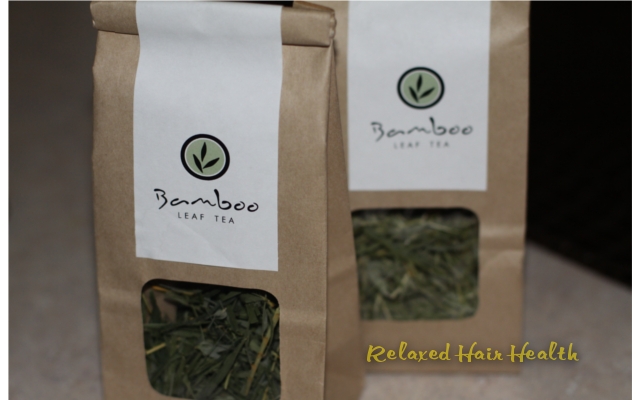
Bamboo Leaf Tea Giveaway!

I received lots of great feedback from readers who were interested in a Bamboo Tea Giveaway after reading my first post on the hair benefits of bamboo. I've really been enjoying this tea and I know you will too. So I've opened the giveaway up to two lucky winners.

So here's how to enter:
  • Send an email to relaxedhairhealth@gmail.com and title it "bamboo tea."
  • Let me know if you prefer loose leaf or tea bags.
  • Follow the blog :)
By the way, the grower of these bamboo plants said she could work with me to make it available for purchase at a special rate for Relaxed Hair Health readers. Would you guys be interested?UPDATED TO ADD: Bamboo Tea is now available at a really great price. Check out this link to find out more!


Bamboo Tea! Yet another way to get your silica fix.

A couple weekends ago, hubby and I were enjoying a leisurely walk downtown. Just as we were completing our rounds, we noticed that several vendor's were setting up a local farmer's market. My interest was immediately peaked as to what possible gem I could find among these local retailers.

We strolled between booths showcasing hand crafted jewelry, home made aprons, specialty pet goodies, etc. Then I saw it, the bamboo booth. It was this humble little stand where a woman and her daughter were offering bamboo plants for sale. We've been looking for bamboo plants forever so we immediately made a beeline to see what the cost of the plants were. The three of us engaged in conversation about how to care for bamboo plants, the cost, and so forth. Then as my husband and the vendor start chatting, her daughter (who was probably 5 years old), comes to me and says this, "my mom drinks a lot of bamboo tea and it made her hair grow." All of the sudden I was brought back to my silica post. You may remember me stating that bamboo is one of the richest sources of silica occurring naturally. In fact, bamboo is a much more potent source of silica than horsetail.

Before the little girl said anything I to me, was only focused on the the plants. I didn't even pay attention to the tea they had available for sale. How did the little girl know that I was a certified hair lush? How did she know.....

Either way, I'm glad she said that cause my very next move was to buy a bag of tea leaves. She even had some tea fresh brewed tea available for consumption. We bought two cups of tea, a bag of leaves and we were on our way.

Bamboo tea is surprisingly light and easy to drink. It's made from the leaves of various bamboo plants. Served chilled, it's a great "summer" tea because of it's light taste. I normally don't sweeten my tea so at times I've had to endure bitterness associated with other teas I've tried. Bamboo tea, to me, has absolutely no bitterness whatsoever. Because of this, I know I'll be consuming tons of this in the days to come.


Because it's a loose tea, I have to employ my little handy dandy loose leaf tea pot. The process is pretty simple, I add the loose leaves to the pot, pour in the hot water and let rest take care of itself. I can usually steep the leaves several times, meaning once I've finished drinking what's in the pot, I just refill with hot water and start the process over.

Along with the rich supply of silica, bamboo tea leaf also contains dietary fiber. It's caffeine free unlike some of the other teas on the market. Plus add the fact that bamboo is a source of antioxidants. All in all, I would say this is a beverage of choice for anyone who is looking to support their skin and hair health. By the way, I just want to say that I've only suffered 2 breakouts since I've taking silica. In the past, I was always battling acne. Now, it's a rare occurrence, it once was the norm for me.


If you aren't into the whole "tea" thing, you can still opt to get your dose of bamboo silica in pill form. To be honest with you, bamboo tea leaves aren't as readily available for purchase as green or other more common leaves. You might be able to find bamboo shoots in a can in the ethnic food section of our local grocer. Either way, I think bamboo is a cost effective way to add silica into your regimen.

Would you guys be interested in a bamboo tea giveaway? Leave a comment below or post in the discussion section of the blog.

Which came first the deep condition or the shampoo? My dry deep conditioning experience


Do you guys remember my review of Hair Fixer way back when? During the six weeks I used the product, I had to forgo using conditioner per their usage instructions. After that experience I learned to place a higher value on the pre-poo step. Since I couldn't deep condition as normal, I had to amp up my pre-poo by using higher quality product. Ever since I've paid close attention to maintain a pretty healthy pre-shampoo regimen but this time I decided to take it a step further.

Instead of using conditioners like Long Term Relationship, etc for my pre-poo, I decided to go all out and conduct a full deep conditioning (pre-shampoo) session. On dry hair, I applied a mix of my favorite high quality conditioners like Biolage, Silicon Mix Protein de Perla, Aveda Damage Repair, and other heavy hitters. I also added a little Argan oil and popped open some vitamin e capsules into the mix. Then I proceeded to part my dry hair into small sections and applied liberally.


Next I finished it off as I would any deep conditioning session, with heat. After 30 minutes or so under the dryer, I jumped in the shower and proceeded to cleanse the hair with WEN. Just before I jumped out of the tub, I reapplied some conditioner to the hair and allow it to sit on the hair for a couple of minutes before the final rinse with cold water. After that rinse, I proceeded with styling. The coolest part about this process was that I only had to jump in the shower only once which is way more efficient than my traditional way of doing things.

So the question I have to ask myself is whether or not this method is more beneficial to the hair or is the time savings the only benefit. To better answer this question one has to look at what happens when the hair becomes wet. Water is easily absorbed into our hair strands. In fact, our hair is so attracted to water that it'll readily pull water from the air. That's why we're constantly fighting against frizz in humid weather. The hair strand can expand as much as 30% when exposed to water. When I think about this swelling effect water has on the hair I ask myself, "is it possible that the absorbed water could be taking up valuable space in my strand that should be granted to my conditioner?"

If that's the case, then it would make sense to apply conditioner to dry hair, then utilize heat to open the cuticle layer, and allow the deep conditioning process to happen. I can tell you from my experience that I had less hair loss this wash then in previous sessions. Not only did I realize some great benefits during the wash, I also enjoyed great feeling hair throughout the week. Dry deep conditioning requires more product then normal deep conditioning. I found myself having to apply ample conditioner just to saturate the hair. In the long run, I'm sure it'll be a little more expensive since I use less conditioner during my normal routine. But I think the results will speak for themselves. You should also check out a post a while back sharing the details of a study that supports the importance of applying product to the hair prior to the wash for added protection to the cuticle layer.


Some might be thinking, "isn't having lots water in the strand a good thing?" Yes it can be a good thing but remember that water evaporates. If I can help it, I'd rather have the deep conditioning ingredients swelling up the strand, no just water alone. The key to making this process successful is using heat to open the up cuticle layer so the conditioner can truly penetrate. Once the cuticle is open, your hair is ready for 100% conditioner penetration. No additional water taking up any valuable cuticle space.

I'll be using this method over the next several weeks to see if the benefits are lasting. I really hope this will turn into a permanent change in my regimen. The thought of saving time on wash day and the possibility of a deeper conditioning process gets me all excited. Anyone tried this technique before?